What is the Future of Social Media?

We live in a world full of social media. Whether we’re browsing people’s photos on Facebook from our computers or updated a status on Twitter from a phone, social media is all around. This form of media happened so fast and is relatively new, so is it just a fad or is it here to stay?

According to Charlene Li, one of the most respected voices in social media, the future of “social media will be like air.” No offense to Charlene Li, but I think we are already there. People rely on social media heavily every day whether it’s to find out what they’re friends are doing, to get news around the world, or any number of other possibilities. Personally, I know that I don’t go a day without checking at least one of my social media platforms. It’s become part of my life, but I’m not sure it will always be that way.

I remember being in middle school and high school and the big thing was MySpace. MySpace began to disappear when Facebook started, and although MySpace just relaunched, it’s still not very popular. The other big thing I used around that age was AOL Instant Messenger (AIM). You’d say goodbye to your friends as the school day ended and then head home just so you can talk to them again. I can’t remember when AIM fizzled out, but none of my friends go on AIM anymore. Instead we use Facebook, Twitter, and text messaging to stay connected.

I’m not the only one that has witnessed this change. Geoff Livingston said, “I feel pretty safe in saying we’re looking at an AOL-esque decline for Facebook.” Facebook has been a huge part of the rise of social media. It even had a movie made about it. Lately, the stock for Facebook has been declining and it’s competing with more and more social media platforms.

I don’t see social media fading out anytime soon, but as technology continues to grow and people learn new ways to use media forms, social media will fade away to the next fad.
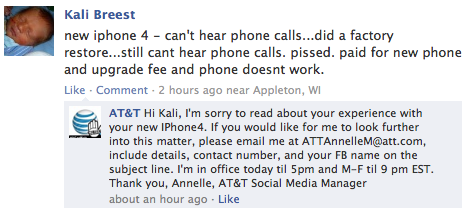
The Social Media Customer Service of AT&T

Social media has opened many doors for companies. One way social media can be used is for customer service. One company does a great job with social media customer service: AT&T. According to Simply Zesty, AT&T has 1.6 millions fans on Facebook. They receive hundreds of questions everyday and the company uses it for customer service and to create positive experience for users.

AT&T does a few things very well. First off, they use their page for discussions. Wall posts and discussion boards can be a great space for customer service to take place, but companies often forget to use them.  When customers post on Facebook, an AT&T customer service rep will respond to them.  Their Facebook page gives people another outlet to contact AT&T instead of calling the customer service line. Personally, I’m an AT&T customer and I know that it can be a pain to call them, so this gives me another outlet to use.

Another thing that makes AT&T’s digital customer service a great tool is they educate their employees in weekly digital leadership workshops. This is to make sure there is a collaboration between all departments and that employees communicating the same messages offline or online.  This is important, especially within an organization as large as AT&T.  Customers need to have consistent messages from the company so they know it’s credible and communicates the correct information.

Although AT&T does a great job with social media customer service, there are still a few thing they can do to improve it. Social media is all about being instant, so fast response times are important.  First of all, the could increase their response time to questions or complaints.  I logged on to their Facebook page and I had to scroll down to posts from two hours ago to find responses.  Other organizations reply faster. The Delta Airlines twitter page responds much quicker than AT&T.

Second, they can employ more people to handle their social media customer service. Right now they only have 20, so more would be beneficial and could increase response time like mentioned above.

Finally, they could be available 24/7.  On AT&T’s twitter page, they state hours of operation. The Facebook page doesn’t show hours of operation, but I would guess they are the same. Customers want information at all hours of the day, so only being available for some is a downside.

How Social Media Can Help Your Company’s PR

With the rise of the internet and digital age, social media has taken over.  People are always sending tweets, checking their Facebook feed, or reading blogs for news.  With this technology and the different social media sites, information is at our finger tips.  So how does this affect the PR?

It can be argued that social media can make things more difficult for PR professionals because people can say whatever they want.  A company or PR professionals cannot control what others say about them on their Facebook, Twitter, or other social media platform.  According to an article on Jontus Media, social media has made it easier for customers to complain.  Without the face-to-face interaction, people are more comfortable writing reviews.  Too many bad reviews, and the company’s reputation could be ruined.

Event though social media can negatively impact a company based on reviews, it is still possible for social media to help a company.  The best thing for a company to do is to take a proactive approach by monitoring and responding to reviews.  By showing they care and by taking the information their customers give them, they can make a plan to ensure the company is seen in a positively.

Building or rebuilding a reputation is not the only thing social media can be used for.  Social media can be very beneficial for a company’s PR because of three reasons:

  1. Increased News Coverage:
    Social media is a great way for companies to show the public what they are doing.  News that would originally be given to tradition media sources via press releases can now be posted on a company’s Facebook or Twitter.  It also means the news can spread faster.  If someone finds a post from a company interesting, they can retweet it or send it to their friends.
  2. Consumer Interactions:
    Before the digital age, if a consumer had a question or complaint about a service or product, they’d need to call a company line and wait to speak to a representative.  Social media has changed that.  It is not possible to tweet a question to a company to have the issue resolved.  I myself have done this before.  Nike offers a service called Nike+ to track workouts.  One day my sensor didn’t record my run, and I didn’t know how to fix that, so I sent them a message on their Facebook page and within minutes I had a response and a fixed product.  It’s immediacy with responses that makes social media an important part of consumer relations.
  3. Cheap or Free Advertising:
    Social media platforms provide a place for companies to showcase their products or services.  It is also a great way to advertise in a less expensive way. One post on a company’s Facebook can spread like wildfire to people’s newsfeeds.  Or a company’s product posted on Pinterest can be repinned thousands of times.  It is hard to pay for advertising that reaches so many people the way social media does.

Although people believe social media can be negative for companies, the positives it brings outweighs the negative.